The Definitive Guide to Answer Engine Optimization (AEO) in 2026
In the early days of the internet, searching was a scavenger hunt. You typed a few keywords into a box, and Google provided “ten blue links.” You clicked, scanned, went back, and clicked again until you found what you needed. This era of “manual searching” required the user to do the heavy lifting of synthesizing information.
Fast forward to 2026, and that behavior feels like ancient history. Today, we don’t just search; we ask. Whether we are talking to a smart speaker, typing a natural language query into a generative AI assistant, or viewing AI-generated summaries on search results pages, we expect instant answers. This shift has transformed how content is created and consumed, leading to the rise of Answer Engine Optimization (AEO). In this AEO Guide 2026, you’ll learn how this new approach helps businesses and creators deliver direct, accurate answers that meet modern user expectations.
Answer Engine Optimization (AEO) is the practice of optimizing content specifically for “Answer Engines”—AI-driven platforms like Google Gemini, OpenAI’s SearchGPT, and voice assistants like Alexa or Siri. While traditional SEO focuses on making a webpage rank as high as possible in a list, AEO focuses on making your content the definitive answer that the engine chooses to display or read aloud.
In 2026, the search experience is conversational and predictive. Answer engines don’t just find keywords; they understand the semantic relationship between entities. If you ask, “What is the best way to clean a velvet sofa?”, the engine doesn’t simply match keywords—it understands the context. It looks for an authoritative source that understands the delicacy of velvet, the chemical reactions of cleaners, and the step-by-step safety precautions required. This is exactly what modern search demands. In this AEO Guide 2026, you’ll understand that AEO is about showing search engines that your content is the most reliable source for a specific topic, ensuring it gets selected as the best possible answer.
SEO vs. AEO: Understanding the Strategic Divergence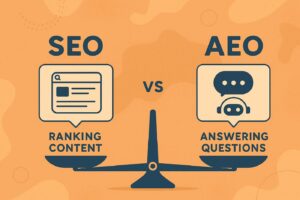
It is a common misconception that AEO replaces SEO. In reality, AEO is a specialized branch of the SEO tree. However, the strategies for each differ significantly in their execution and psychological approach.
The SEO user is often in a “browsing” or “research” mindset. They are willing to click through various pages to compare information. In contrast, the AEO user is in an “immediate” mindset—they need an immediate solution to their problem. This shift in behavior requires content creators to move away from long-winded storytelling and focus on utility-first writing. If your value is buried under 1,000 words of unnecessary content, an answer engine will likely skip it in favor of a competitor who delivers clear and direct answers. As highlighted in this AEO Guide 2026, creating concise, structured, and answer-focused content is essential to meet modern search expectations and stay competitive.
- Primary Goal: SEO wants you to click; AEO wants you to know.
- Target: SEO targets crawlers; AEO targets Large Language Models (LLMs).
- Content Unit: SEO optimizes the page; AEO optimizes the information fragment.
- Query Type: SEO uses keywords; AEO uses natural language intent.
Why AEO is the “Make or Break” Strategy for 2026
The search landscape has been permanently altered by several technological milestones that have made AEO the primary battlefield for digital marketing.
The Proliferation of Generative AI
AI models now synthesize information from across the web. Instead of sending a user to your blog post about “how to bake bread,” the AI reads your post (and three others) and creates a summary. AEO ensures that the AI chooses your specific steps and credits your brand. Without AEO, you risk becoming “ghost content”—content that helps train the AI but never gets seen by a human user.
Voice Search and “Eyes-Free” Information
With the refinement of natural language processing (NLP), more than 50% of searches are now voice-activated. Whether it’s someone driving a car asking for a recipe or someone in the kitchen asking for a conversion, voice assistants don’t read a list of results; they read one result. If you aren’t optimized for AEO, you effectively don’t exist in the voice search ecosystem.
The Rise of Zero-Click Searches
Users are increasingly finding what they need directly on the Search Engine Results Page (SERP). While this sounds scary for website traffic, being the source of a zero-click answer builds massive brand equity. In 2026, “Brand Authority” is the new “Domain Authority.” If an AI constantly cites your business as the source of truth, users will eventually go directly to your site when they are ready to make a purchase.
How Answer Engines “Think”: The Mechanics of Retrieval
To optimize for AEO, you must understand the journey an AI takes to find an answer. It is a highly sophisticated process that happens in milliseconds.
Intent Parsing and Semantic Mapping
When a user asks a question, the engine doesn’t just look for matching words. It parses the intent. Is the user looking for a fact (informational), a location (navigational), or a product (transactional)? The engine then uses semantic mapping to find concepts that are related to the query, even if the exact words weren’t used. This is why using synonyms and related topics within your content is vital for AEO success.
Synthesis and Attribution
The engine takes the best snippets of information and reformats them into a cohesive answer. This is where formatting becomes your best friend. If your content is organized in a way that is easy to “copy-paste” into an AI summary, you are much more likely to be featured. The engine then provides a citation—a link to your site—which serves as the new form of a “click.”
Core Strategies to Master AEO
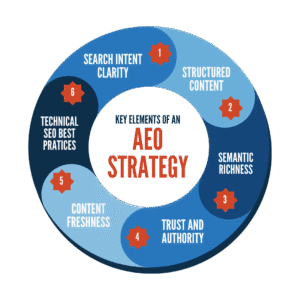
To win the “Answer Game,” your content needs to be both machine-readable and human-satisfying. This requires a two-pronged approach: technical precision and editorial clarity.
Structure Content for “Snippet-ability”
Answer engines love structure. They are looking for clear “hooks” to grab information.
- Use H2 and H3 tags as questions. Instead of a heading that says “Velvet Cleaning Tips,” use “How do you clean a velvet sofa without ruining the fabric?”
- Follow the “Definition-First” rule: Immediately after a question heading, provide a 40–60 word direct answer. This is the “sweet spot” for AI models to extract and use as a featured snippet.
- Use Tables and Lists: AI engines find it much easier to parse data presented in a structured format. If you are comparing two products, use a table. If you are listing steps, use a numbered list.
Implement Advanced Schema Markup
Schema is the “secret language” you use to talk directly to AI. By using JSON-LD structured data, you can explicitly tell an answer engine exactly what your data represents. This removes the guesswork for the AI.
-
FAQ Schema:
This is one of the most important technical elements for AEO. It clearly tells search engines what questions your content is answering. As explained in this AEO Guide 2026, using FAQ schema increases your chances of appearing in featured snippets and voice search results.
-
How-To Schema:
This is essential for instructional or step-by-step content. It allows AI systems to present your content in a structured sequence. According to this AEO Guide 2026, properly implemented how-to schema helps search engines easily extract and display actionable steps.
-
Organization Schema:
This schema establishes your brand’s authority by connecting your business details, social profiles, and contact information into a structured format. As highlighted in this AEO Guide 2026, it helps build trust and supports your presence in knowledge panels and AI-driven search results.
The Role of E-E-A-T in the AEO Era

Answer engines are programmed to avoid “hallucinations” and misinformation. They prioritize sources with high Experience, Expertise, Authoritativeness, and Trustworthiness (E-E-A-T).
Proving Expertise to an AI
In 2026, AI engines look for signals of real-world experience. This includes:
-
Author Bios:
Every piece of content should be tied to a real person with a strong digital presence in that industry. This builds trust and credibility. As highlighted in this AEO Guide 2026, search engines prefer content created by identifiable experts rather than anonymous sources.
-
Citations and References:
Linking to government websites, academic journals, or recognized industry leaders signals that your content is reliable and well-researched. According to this AEO Guide 2026, strong references help AI understand that your answer is based on accurate and trusted information.
-
Niche Authority:
It is more effective to become the “Answer King” in a specific niche rather than trying to cover everything. Focusing on a targeted area builds deeper authority. As explained in this AEO Guide 2026, niche expertise increases your chances of being selected as the best answer for related queries.
Common AEO Pitfalls to Avoid

-
The “Wall of Text” Mistake:
Long, unbroken paragraphs are the enemy of AEO. They are difficult for AI to parse and even harder for humans to read on mobile devices. As highlighted in this AEO Guide 2026, content should be broken into short paragraphs, headings, and bullet points for better readability and extraction.
-
Using Complex Jargon:
If your answer is too technical, an AI may consider it unhelpful for the average user. Aim for simple, clear language that a wide audience can understand. According to this AEO Guide 2026, writing at a basic reading level improves both user experience and answer selection.
-
Neglecting Page Speed:
Even in an AI-driven search environment, speed matters. If your site takes too long to load, search engines may skip your content entirely. As explained in this AEO Guide 2026, fast-loading pages are essential to ensure your content is quickly accessed and delivered as an answer.
The Future of AEO: Personalization and Multimodality

As we look toward the end of the decade, AEO will become even more personalized. AI agents will not just provide “the best answer,” but “the best answer for you,” based on your previous preferences, your location, and even your current mood or urgency. This level of personalization is transforming how users interact with search, making relevance and context more important than ever. As highlighted in this AEO Guide 2026, adapting to personalized search experiences will be key to staying competitive.
Furthermore, the rise of multimodal AEO means that video and audio will become just as searchable as text. In 2026, an answer engine might respond to a query by showing a short clip from your video or playing a snippet from your podcast. This shift requires content creators to optimize beyond written content. Following the strategies in this AEO Guide 2026, optimizing multimedia content with accurate transcripts, captions, and metadata will become the next frontier of answer engine optimization.
Conclusion
Answer Engine Optimization isn’t just a buzzword; it’s a fundamental shift in how we interact with the digital world. In 2026, the brands that win aren’t those with the most content, but those with the most useful and relevant content. By focusing on direct answers, clear structure, and strong authority, you ensure that when users ask a question, your brand is the one providing the best answer. As explained in this AEO Guide 2026, success comes from delivering value instantly rather than relying on long-form content alone.
The future of search is no longer about finding a link; it’s about finding a solution. Users expect quick, accurate responses without unnecessary effort. This means your content must be structured, concise, and highly informative. Following the strategies in this AEO Guide 2026 will help ensure your content is ready to meet these expectations and stand out as the most reliable answer.
Author:Mohammed Sabin